
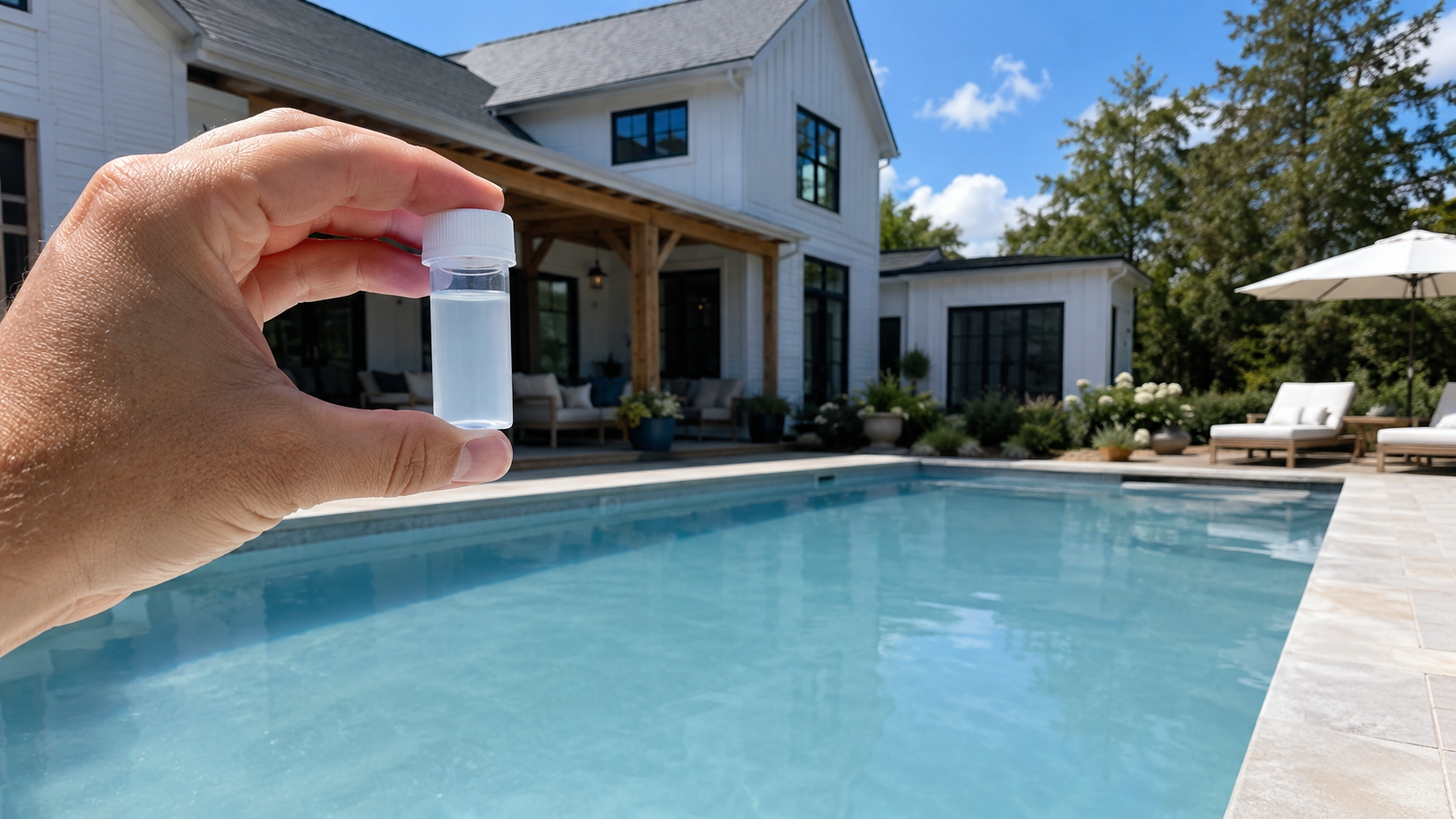

This one drives pool owners crazy.
You test the water.
The numbers look fine.
You add chlorine anyway.
You clean the filter.
You brush the walls.
You run the pump longer.
And still, the pool looks cloudy.
Not green.
Not disgusting.
Just dull.
Hazy.
A little tired.
Like someone turned the sharpness down on your backyard.
So what is going on?
Here is the truth:
Sometimes cloudy water is not a chlorine problem.
Sometimes it is an old water problem.
Clear Water and Balanced Water Are Not the Same Thing
A pool can be technically “balanced” for the day and still have deeper water quality problems.
That sounds strange, but it happens all the time.
Your pH might be acceptable.
Your chlorine might show up on the test strip.
Your alkalinity might not be terrible.
But if the water is loaded with dissolved solids, calcium, old chemicals, phosphates, oils, metals, and stabilizer, the pool still has a problem.
It is not always dirty in the way people imagine.
It is saturated.
Think of it like trying to wash a window with a dirty rag.
You can keep wiping, but the film never really goes away.
That is cloudy pool water.
The Filter Can Only Do So Much
Your pool filter is important.
Very important.
It catches leaves, dirt, bugs, hair, and larger debris that move through the system.
But your filter is not designed to remove everything.
It does not remove dissolved calcium.
It does not remove cyanuric acid.
It does not remove total dissolved solids.
It does not remove salt.
It does not remove every microscopic contaminant that has built up over years of swimmers, chemicals, fill water, and evaporation.
That is why the pool can still look cloudy after you clean the filter.
The issue is not what is floating in the water.
The issue is what is dissolved in the water.
The “Full Glass” Problem
Fresh pool water has room to work.
Chemicals can dissolve properly. Chlorine can move quickly. The water can hold minerals without dumping them onto the surfaces. The whole system feels easier.
Old water is different.
It gets full.
Calcium builds up.
CYA builds up.
TDS builds up.
Phosphates build up.
Chemical byproducts build up.
Once the water gets too full, it loses that clean, polished look. You may still be able to keep it from turning green, but it never looks amazing. It never has that crisp, inviting, first-dive feeling.
It just looks tired.
Why More Chlorine Is Not Always the Answer
This is the mistake most homeowners make.
Cloudy water shows up, so they add more chlorine.
Sometimes that helps.
But if the water is already chemically saturated, adding more can become part of the problem.
More chlorine products can add more byproducts.
More shock can raise other levels.
More tabs can raise stabilizer.
More chemicals can create more demand for even more chemicals.
That is the cycle.
You are trying to clear the water by adding more to water that is already overloaded.
At some point, the better move is not adding.
It is removing.
Common Causes of Cloudy Pool Water
Cloudy water can have several causes, and sometimes more than one thing is happening at the same time.
Here are the big ones:
1. Poor Filtration
If your filter is dirty, damaged, undersized, or not running long enough, the water will not circulate and clean properly.
2. High Calcium Hardness
Hard water can cause cloudiness, scale, and rough surfaces, especially when pH and temperature rise.
3. High Cyanuric Acid
CYA protects chlorine from the sun, but too much of it can slow chlorine down and make the pool harder to sanitize.
4. High Total Dissolved Solids
TDS is the collection of dissolved material in the water. When it gets too high, the water becomes harder to manage and can lose clarity.
5. Phosphates and Organic Load
Phosphates feed algae. Even before a pool turns green, chlorine may be working overtime against microscopic growth.
6. Oils, Sunscreen, and Heavy Swim Use
A busy pool collects sunscreen, sweat, lotion, hair products, and everything else people bring in with them.
That is why some pools look fine all week, then get cloudy after a weekend of heavy use.
When Cloudy Water Needs a Reset
If your pool gets cloudy once and clears up quickly, it may just need normal attention.
But if cloudiness keeps coming back, pay attention.
That is usually your water telling you something deeper is off.
You may need a water reset if:
- The pool looks dull even when chlorine and pH are acceptable
- You keep shocking but the haze returns
- Your filter is clean but the water still looks cloudy
- Your calcium hardness is high
- Your CYA is high
- Your TDS is elevated
- You are using more chemicals than you used to
- The water feels hard, sticky, or irritating
At that point, you are not dealing with a one-time cloudiness issue.
You are dealing with buildup.
How Reverse Osmosis Helps
At California Pool Co., we use reverse osmosis to remove the dissolved buildup your normal filter cannot touch.
Instead of draining the pool and starting over with tap water, we purify the water already in your pool.
That means we can reduce calcium hardness, cyanuric acid, total dissolved solids, phosphates, salt, and other contaminants that make the water harder to manage.
After the water is reset, it becomes easier to balance.
Chlorine works better.
The water feels softer.
The pool looks sharper.
You stop fighting the same haze over and over again.
Final Thought
Cloudy water is not always a sign that you need more chemicals.
Sometimes it is a sign that your pool has had too many chemicals for too long.
That is the difference.
If the water looks dull, feels off, or keeps getting cloudy no matter what you add, it may be time to stop chasing the symptom and fix the source.
Clean water is not just water that passes a quick test.
It is water with room to breathe.
If your pool has lost that clear, polished look, California Pool Co. can test your water and help you decide whether reverse osmosis is the reset your pool needs.