
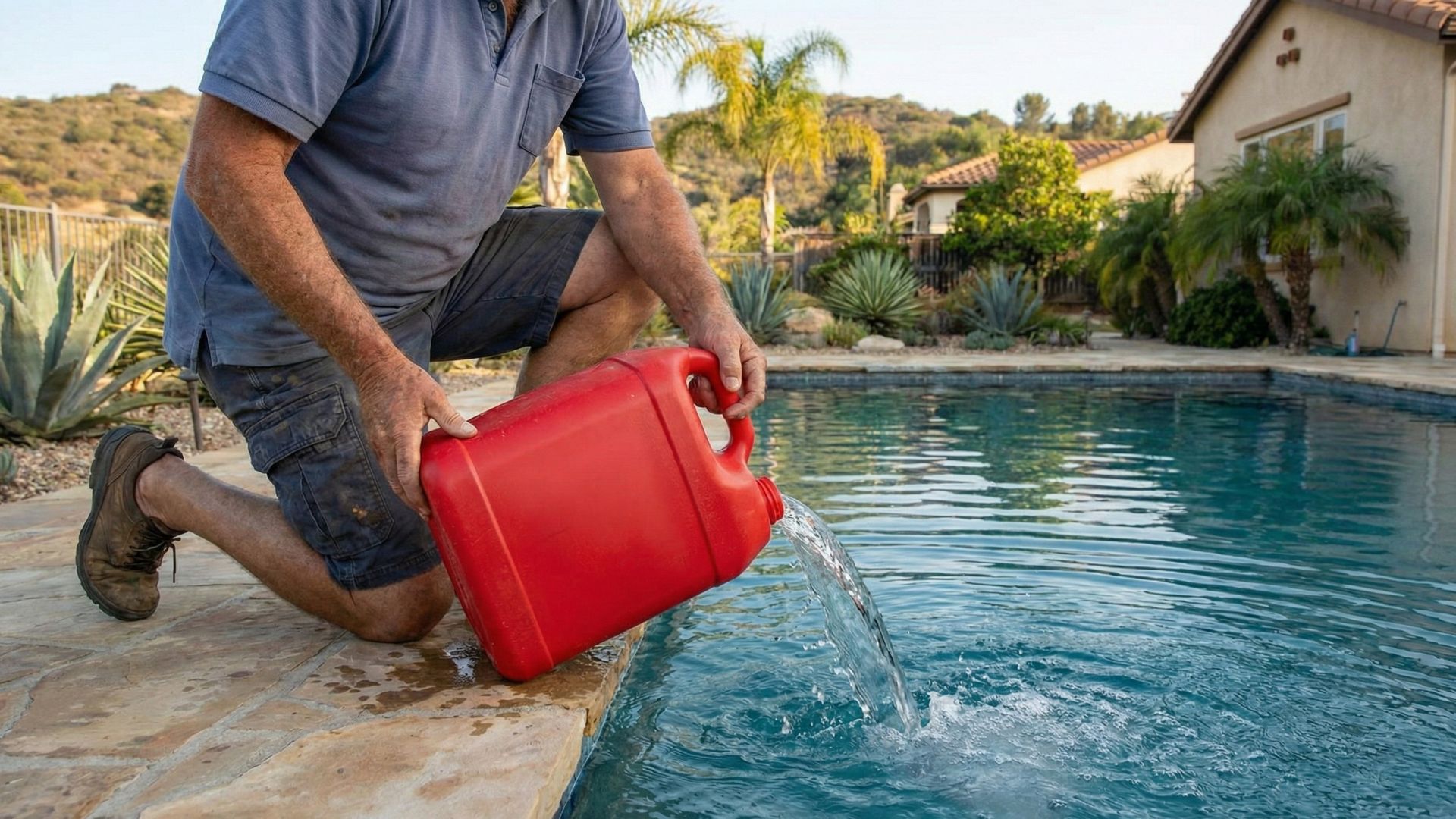

Does it feel like you are feeding your pool chlorine, but it’s never enough? You shock it on Monday, but by Wednesday, the levels have bottomed out again. Or perhaps you’ve noticed you are buying twice as many buckets of tabs as you did a few years ago just to keep the water clear.
If you find yourself asking, "Where is all the chlorine going?" the answer usually isn't that you aren't adding enough. The answer is that your water is fighting back.
Here are the top reasons your pool’s chlorine demand has skyrocketed—and why adding more chemicals isn't the fix.
1. The "Chlorine Lock" (High Cyanuric Acid)
The most common culprit for high chlorine demand in California pools is Cyanuric Acid (CYA), also known as stabilizer.
Stabilizer is necessary in small amounts (30–50 ppm) to protect chlorine from the sun. However, because stabilizer is added to almost every standard chlorine tablet (trichlor), your CYA levels rise every time you sanitize your pool. Unlike chlorine, CYA never evaporates. It stays in the water forever.
The Problem:When CYA levels get too high (often 100 ppm or higher), it over-protects the chlorine. It "locks" the sanitizer up so tightly that it can’t work.
- The Result: You have to add significantly more chlorine just to break through that "lock" and get any sanitation power. You are essentially paying a "chlorine tax" just to overcome the high stabilizer levels.
2. The "Full Sponge" Effect (High TDS)
As your pool water ages, it accumulates Total Dissolved Solids (TDS). This includes calcium, magnesium, salt, microscopic debris, and the remnants of every chemical you’ve ever added.
Think of your pool water like a sponge. Fresh water is a dry sponge—it absorbs chemicals easily. Old water with high TDS is a soaking wet sponge. It’s saturated.
- The Result: When TDS is high (typically over 2,500 ppm), chlorine becomes sluggish and inefficient. You have to use higher doses to get the same clarity you used to get with a single tablet.
3. Phosphates (The Algae Buffet)
Phosphates are microscopic nutrients that enter your pool from wind, rain, dirt, and landscaping runoff. They are essentially a "superfood" for algae.
- The Result: Even if you don't see green algae yet, your chlorine is working overtime fighting microscopic growth fueled by phosphates. Your chlorine is being "used up" fighting an invisible enemy before it even has a chance to sanitize the rest of the pool.
How to Lower Your Chlorine Demand
If you are tired of carrying heavy buckets of tablets and shocking your pool constantly, you need to reset your water chemistry.
In the past, the only way to lower CYA, TDS, and Phosphates was to drain the pool and refill it. But in California, draining is risky (for the pool shell) and wasteful.
The Smarter Solution: Reverse Osmosis (RO)At California Pool Co., we use mobile Reverse Osmosis filtration to solve this exact problem.
- We remove the "Lock": We filter out the excess Cyanuric Acid so your chlorine can work freely again.
- We empty the "Sponge": We lower TDS levels, giving you water that feels and acts brand new.
- We save the water: We conserve up to 85% of your existing water, returning it to your pool cleaner than bottled water.
Stop feeding your pool endless chemicals.If your chlorine consumption is out of control, it’s time for a reset. Contact us today to schedule a consultation and get your pool running efficiently again.