
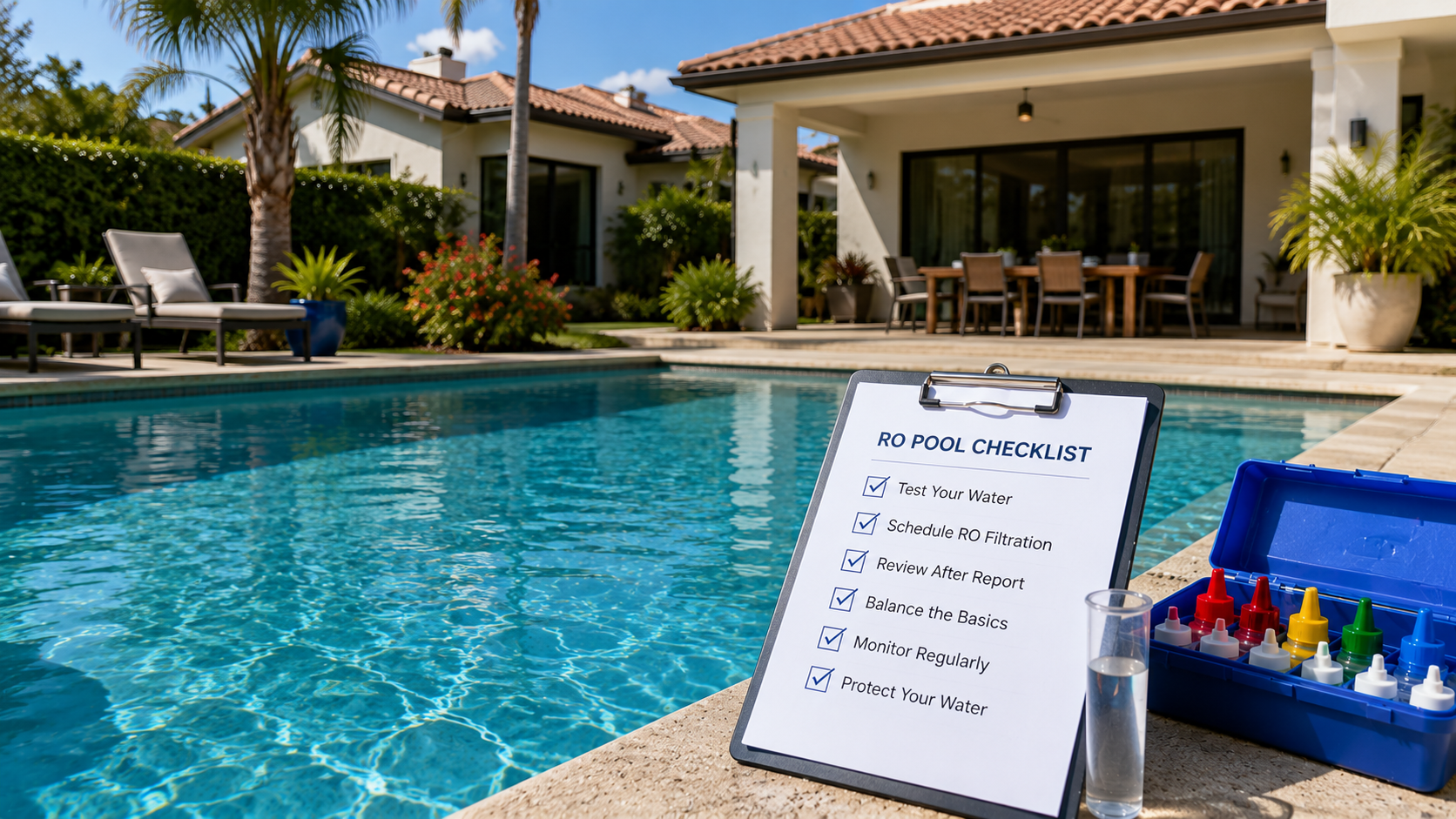

Reverse osmosis gives your pool a fresh start.
That is the big win.
But a fresh start is not the same thing as “do nothing forever.”
After RO filtration, your water is cleaner, softer, and much easier to manage. The calcium, CYA, TDS, phosphates, salt, and other buildup have been dramatically reduced. The water is no longer fighting you the same way it was before.
Now the goal is simple:
Do not let it fall back into the same cycle.
Here is how to keep your pool feeling great after reverse osmosis.
Start With the Right Mindset
Before RO, many pool owners are in survival mode.
Add more chlorine.
Shock it again.
Brush the tile.
Clean the cell.
Fight the algae.
Lower the pH.
Raise the alkalinity.
Try another bottle of something from the pool store.
It becomes a routine of correction.
After RO, you get to shift into prevention.
That is a much better place to be.
You are not trying to force bad water to behave anymore. You are maintaining clean water from a strong baseline.
That means less panic, less waste, and fewer chemical swings.
1. Test the Water Regularly
After RO filtration, testing matters more, not less.
The difference is that the test results should be easier to manage.
A good weekly test should include:
- Free chlorine
- pH
- Alkalinity
- Calcium hardness
- Cyanuric acid
- Salt, if you have a salt pool
Then, every so often, test for:
- Phosphates
- TDS
- Metals, if staining has been an issue
The goal is not to obsess over every number.
The goal is to notice trends before they become problems.
If pH is drifting, catch it early.
If phosphates are creeping up, deal with them before algae shows up.
If CYA is rising because you are using too many tabs, change the approach before chlorine demand gets out of hand.
Clean water gives you margin.
Testing helps you keep it.
2. Be Careful With Chlorine Tabs
Chlorine tabs are convenient.
That is why people love them.
But most standard tabs contain cyanuric acid. That stabilizer protects chlorine from sunlight, which is helpful in the right amount.
The problem is that CYA does not evaporate.
Chlorine gets used up.
Water evaporates.
But CYA stays behind.
So if you use tabs constantly, your stabilizer level keeps climbing. Eventually, your chlorine slows down, algae becomes harder to control, and the pool starts demanding more sanitizer.
Sound familiar?
That is one of the reasons many pools need a reset in the first place.
After RO, you do not have to swear off tabs forever. You just need to use them wisely.
Think of them as a tool, not the entire plan.
3. Keep Phosphates Low
Phosphates are algae food.
They come from leaves, dirt, fertilizer, sprinkler runoff, sunscreen, sweat, and organic debris.
Even after RO, phosphates can return because your pool is an open system. Wind blows things in. People swim. Landscaping happens. Life happens.
The fix is simple:
Do not let phosphate levels get away from you.
Keep the pool clean.
Empty baskets.
Skim leaves.
Brush regularly.
Consider a phosphate remover as part of your regular maintenance plan if your yard, trees, or runoff make phosphates a recurring problem.
If you keep phosphates low, you make life harder for algae.
That means your chlorine can focus on sanitation instead of constantly fighting growth.