
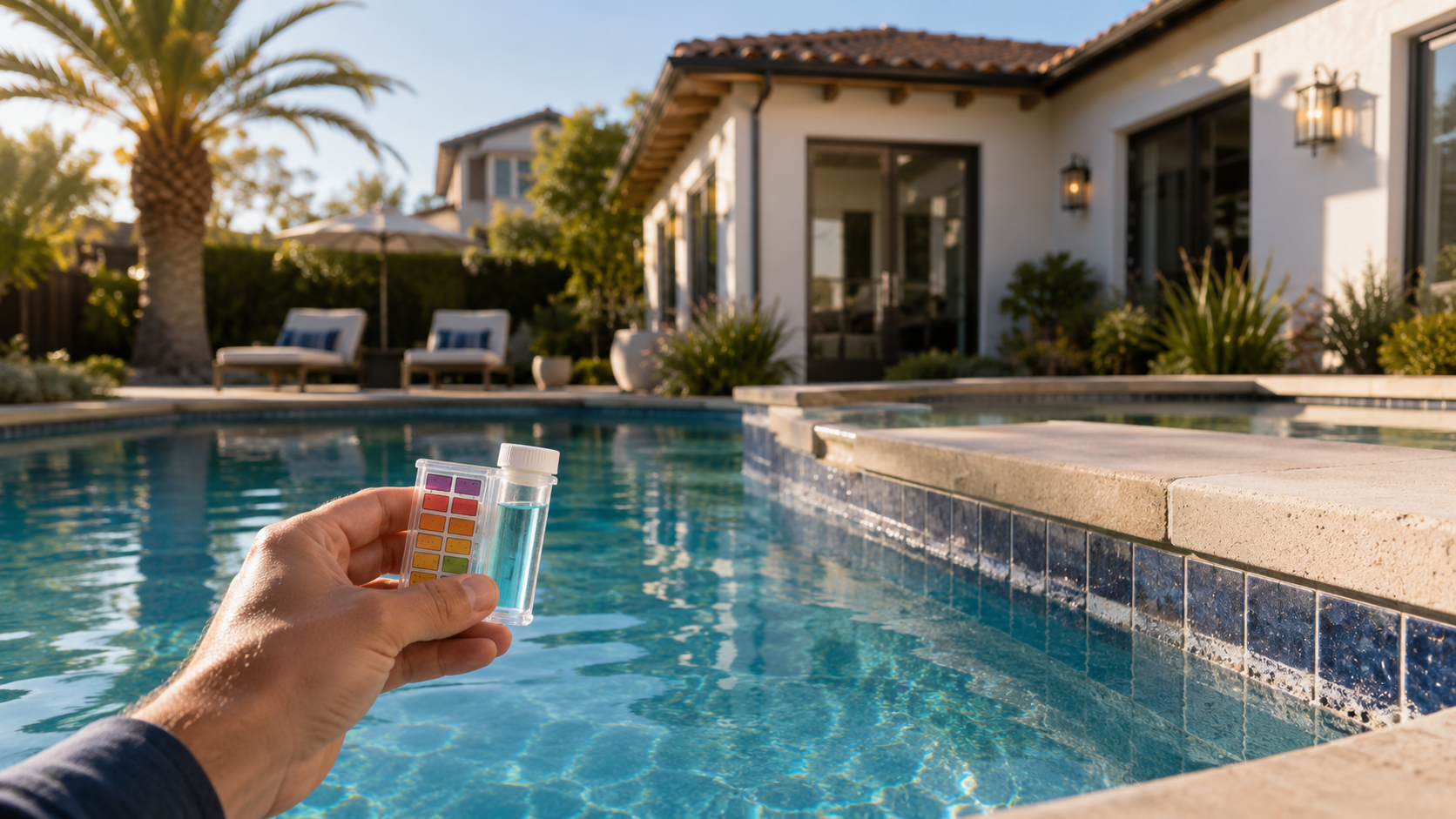

Buying a home with a pool feels like a win. You picture summer afternoons, kids jumping in, friends coming over, the spa running at night, and that first weekend where the backyard finally feels like the reason you bought the house in the first place. During the showing, the pool looks blue. The equipment is humming. The listing photos look great. Maybe the home inspector checks the pump, heater, lights, and visible surface condition, and everything seems good enough to move forward.
But here is the problem most buyers never think about: the pool water itself may be carrying years of someone else’s maintenance habits.
A pool can look clear and still be overloaded with calcium, cyanuric acid, salt, phosphates, total dissolved solids, and chemical residue that has built up over time. That does not always show up in a listing photo. It may not be obvious during a fifteen-minute walkthrough. It may not even look like a major problem during the inspection. But once the home is yours and you are the one paying for chemicals, service, equipment repairs, and water bills, that “beautiful pool” can quickly become one more expensive surprise you inherited from the previous owner.
Most homeowners understand the importance of inspecting a roof, HVAC system, plumbing, electrical panel, foundation, and appliances before buying a home. Those are obvious. They are big-ticket items. They can affect the value of the house. But very few buyers ask a simple question that could save them a lot of frustration later: what condition is the pool water actually in?
Not the pool. The water.
That distinction matters. A pool is a structure, but the water is a system. It is constantly changing, constantly collecting minerals, chemicals, organic material, sunscreen, body oils, leaves, dust, evaporation residue, and everything else that ends up in the backyard. Over months and years, that buildup does not just disappear because the water is blue. Standard pool filters are great for catching debris, but they do not remove everything dissolved into the water. So while the surface may look inviting, the chemistry underneath may be telling a very different story.
One of the biggest issues in California pools is hardness. As water evaporates, calcium and minerals stay behind, and when the pool is repeatedly topped off with more hard water, those levels can continue climbing. Eventually, that can lead to white scale on tile, rough water feel, cloudy water, staining, equipment stress, and a pool that becomes harder and more expensive to balance. A buyer walking through a home may see a little white crust around the waterline and think it is cosmetic, but that scale can be a sign that the water has been carrying high mineral levels for a long time.
Another common issue is cyanuric acid, often called stabilizer or conditioner. It helps protect chlorine from being burned off too quickly by the sun, which is useful in California, but too much of it can make chlorine less effective. The frustrating part is that the pool may still have chlorine in it, and the test strip may still show activity, but the water can become harder to sanitize properly because the chemistry is overloaded. To the new homeowner, this often shows up as a pool that always seems to need more chemicals, gets cloudy too easily, or develops algae even though they feel like they are doing everything right.
This is where a lot of people get stuck. They buy the house, take over the pool, and then spend the first few months trying to “fix” water that has been neglected, over-treated, under-treated, or simply aging for years. They add shock. They add tablets. They brush. They backwash. They ask the pool guy why the water keeps acting up. At some point, someone says, “You probably need to drain it and start over.” And suddenly the new homeowner is looking at wasting thousands of gallons of water, paying to refill the pool, rebalancing everything from scratch, and taking on the risk that comes with draining a pool that may not need to be fully drained in the first place.
That is why testing the water before you buy, or immediately after you move in, is such a smart move. It gives you a clearer picture of what you are inheriting. The water may be perfectly manageable. It may just need normal balancing. But if the test shows high calcium, high total dissolved solids, high stabilizer, or other buildup, you can address the issue before it becomes a long, expensive guessing game.
For buyers, this can also become part of the conversation around the home purchase. If the pool water is in rough shape, that is real information. It may not be as dramatic as a bad roof inspection, but it still affects the cost of ownership. A neglected pool can mean higher chemical costs, more service calls, more scale, more strain on equipment, and a less enjoyable swimming experience. If you are buying a home in a market where every detail matters, knowing the condition of the pool water gives you one more piece of leverage and one fewer surprise after closing.
For sellers, the same idea works in the opposite direction. If you are listing a home with a pool, clean, balanced, comfortable water helps the backyard feel cared for. Buyers may not know how to explain why one pool feels better than another, but they notice when the water looks polished, the tile is cleaner, the surface feels less harsh, and the whole backyard gives off that “well-maintained” feeling. In a competitive real estate market, the pool is not just a feature. It is part of the emotional value of the property.
And for Realtors, this is an easy way to help clients think beyond the obvious inspection checklist. Most buyers are already overwhelmed by documents, deadlines, contingencies, and closing costs. They may not know enough about pool chemistry to ask the right questions. But a simple water test can help them avoid inheriting a pool that immediately needs major attention. It is a small step that can make a big difference in how confident they feel about the home.
The good news is that bad pool water does not always mean you need to dump the pool and start over. Reverse osmosis pool filtration gives homeowners a way to remove the unwanted buildup from the water while keeping most of the water in the pool. Instead of draining thousands of gallons and replacing them with new fill water that may already contain minerals of its own, reverse osmosis filters the existing water and removes many of the dissolved solids that normal filtration leaves behind.
For a new homeowner, that can be the difference between inheriting a problem and resetting the pool properly. Reverse osmosis can help reduce calcium hardness, cyanuric acid, total dissolved solids, salt, phosphates, and other buildup that makes water harder to manage. The result is cleaner, softer, more balanced water without the waste and risk of a traditional drain and refill. It is not just about making the water look better. It is about making the pool easier to own.
That matters because draining a pool is not always as simple as opening a valve and walking away. Depending on the pool type, soil conditions, groundwater, heat, and surface material, draining can put stress on the structure. Empty pools are more vulnerable to cracking, surface damage, and in certain conditions, shifting or popping. Even when nothing dramatic happens, you still have the cost of refill water, the time it takes to rebalance the pool, and the waste of throwing away water that may have been recoverable.
So before you buy a home with a pool, do not just ask whether the pool works. Ask what condition the water is in. Ask when it was last tested beyond the basics. Ask whether calcium, stabilizer, salt, and total dissolved solids are within a healthy range. If the seller does not know, that tells you something too.
A pool should be one of the best parts of buying a home, not the first headache after moving in. Whether you are a buyer trying to avoid surprises, a seller trying to make your backyard more attractive, or a Realtor helping clients make smarter decisions, pool water deserves more attention than it usually gets. Clear water is not always clean water, and a good-looking pool can still come with hidden chemistry problems.
Before you inherit someone else’s pool problems, test the water.
And if the water needs a reset, California Pool Co. can help you refresh it the smarter way with reverse osmosis pool filtration that conserves water, protects your pool, and gives you a cleaner start in your new home.