
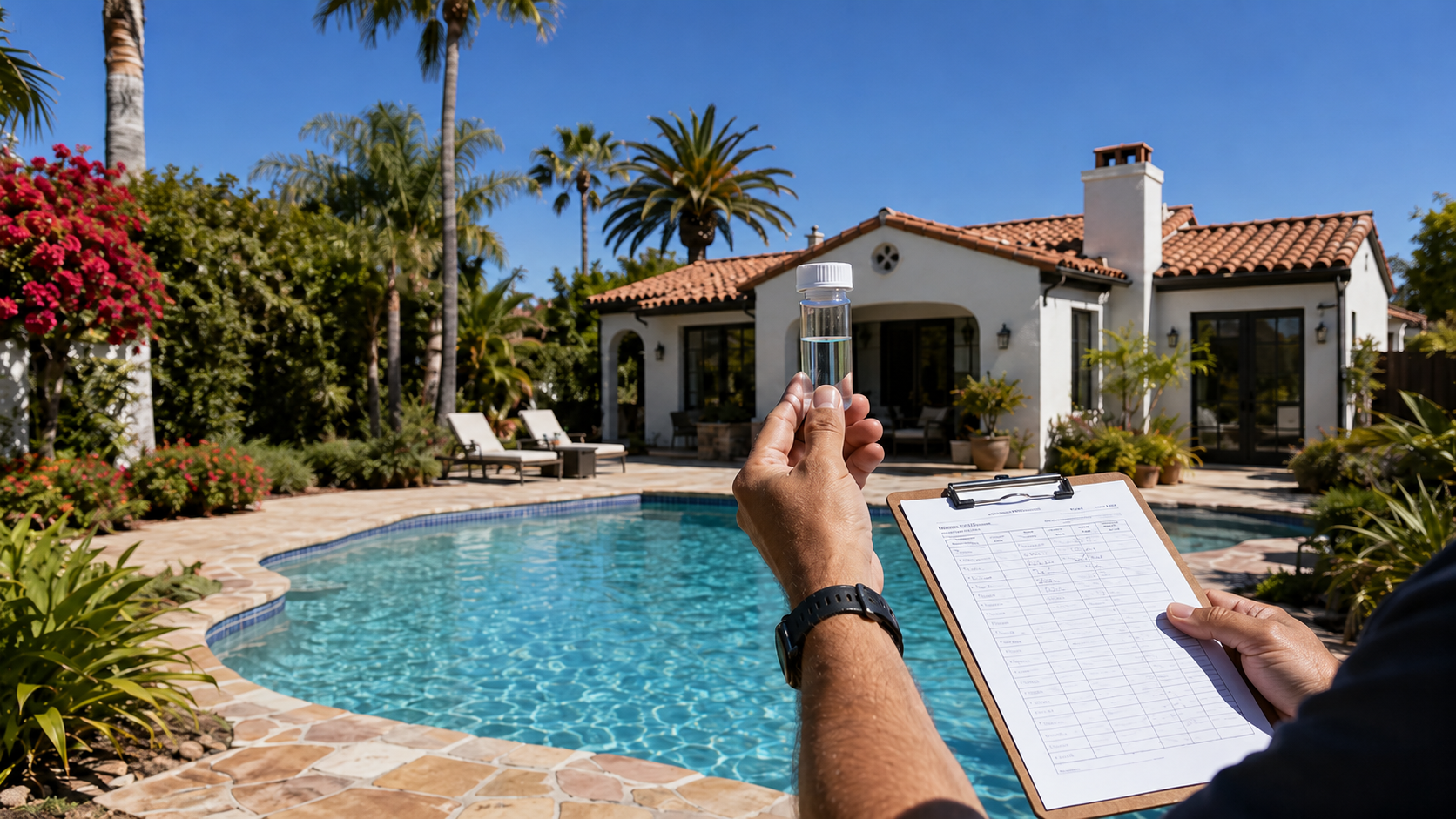

You found the house.
The backyard is beautiful. The pool is sparkling. The sun is hitting the water just right, and suddenly you can already picture summer dinners outside, kids jumping in after school, and friends gathered around the patio.
But before you fall in love with the pool, you need to ask one very practical question:
What is actually in that water?
Because a pool can look good in photos and still be hiding years of chemical buildup, hard water, calcium, cyanuric acid, phosphates, metals, and total dissolved solids.
That does not mean the pool is a dealbreaker.
It just means you need to know what you are inheriting.
Clear Water Does Not Always Mean Healthy Water
Most home buyers judge a pool the same way they judge a kitchen counter.
Does it look clean?
That makes sense. Nobody wants to buy a house with a green pool or a tile line covered in scale.
But pool water is tricky.
Water can look clear and still be overloaded with things your regular filter cannot remove.
That includes:
- Calcium hardness
- Cyanuric acid, also known as stabilizer
- Salt
- Phosphates
- Metals
- Total dissolved solids
- Old chemical byproducts
These build up slowly over time.
The previous homeowner may have done everything they were supposed to do. They may have brushed the pool, cleaned the baskets, shocked the water, and used chlorine tabs every week.
But every chemical added to the pool leaves something behind.
Every refill adds more minerals.
Every hot summer day evaporates clean water and leaves the solids behind.
Eventually, the water gets tired.
The “New House, Old Water” Problem
This is one of the most common things we see.
A family buys a home with a pool. The water looks fine during escrow. The inspector checks the pump, heater, plumbing, and visible equipment. Everything seems good enough.
Then a few months later, the problems show up.
The pool starts needing more chlorine.
The tile gets a white ring.
The water feels rough.
The kids complain about itchy skin.
The salt cell scales over.
The pool service company says, “Your water is old. You probably need to drain it.”
And suddenly, that dream pool starts feeling like a very expensive science project.
The problem was not necessarily the pool.
It was the water.
What Should Be Tested Before You Buy?
If you are buying a home with a pool, ask for a full water test before closing.
Not just chlorine and pH.
Those are important, but they only tell you what is happening today. You need to know what has been building up for years.
A good pool water test should include:
- Free chlorine
- Combined chlorine
- pH
- Total alkalinity
- Calcium hardness
- Cyanuric acid
- Salt
- Phosphates
- Total dissolved solids
- Metals, if staining is visible
These numbers help tell the real story.
For example, high cyanuric acid can make chlorine sluggish. High calcium can create scale. High phosphates can feed algae. High TDS can make the water harder to balance even when you keep adding more chemicals.
In other words, a water test helps you see if the pool is easy to maintain or already fighting back.
The Inspection Usually Misses the Water
A pool inspection is still important.
You want to know if the pump works. You want to know if the heater is functioning. You want to check for leaks, cracks, unsafe drain covers, and equipment issues.
But the water itself deserves its own attention.
Because even a structurally sound pool can become frustrating if the water is already overloaded.
Think of it like buying a used car.
The paint may look great, but you still want to know what is happening under the hood.
Pool water is the same way.
It may sparkle, but the chemistry tells the truth.
Do You Have to Drain It?
This is where most homeowners get discouraged.
Traditionally, when pool water gets overloaded with calcium, CYA, TDS, phosphates, or salt, the answer has been simple:
Drain it and refill it.
But that is a rough way to start life in a new house.
You waste thousands of gallons of water. You pay to refill the pool. You risk exposing the plaster to heat and drying. Then you still have to balance new tap water, which may already contain hardness and minerals before it ever hits your pool.
That is not exactly the welcome-home moment anyone wants.
A Better First Move: Reverse Osmosis
At California Pool Co., we use mobile reverse osmosis filtration to reset pool water without draining the entire pool.
Instead of throwing the water away, we clean the water you already have.
Reverse osmosis can remove the microscopic buildup your normal pool filter cannot touch. That includes calcium hardness, cyanuric acid, total dissolved solids, salt, phosphates, and more.
The result is a clean baseline.
Water that is softer.
Water that is easier to balance.
Water that feels better to swim in.
Water that gives you a fresh start without wasting the whole pool.
The Best Time to Fix Pool Water Is Before It Becomes a Problem
If you just bought a home with a pool, or you are in escrow on one now, do not wait until the water starts fighting you.
Get it tested.
Know the numbers.
Then decide if the pool needs normal maintenance or a true water reset.
Because the best pool problems are the ones you catch before summer, before the kids are in the water every day, and before you have spent hundreds of dollars trying to force bad water to behave.
Final Thought
A backyard pool should be one of the best parts of buying a home.
It should feel like a gift.
Not a mystery.
So before you inherit someone else’s water chemistry, take a closer look. If the water is old, hard, overloaded, or difficult to balance, you do not have to start your pool ownership journey with a drain and refill.
You can start with a clean slate.
And that makes everything easier.
If you are buying a home with a pool, California Pool Co. can test your water and help you understand whether reverse osmosis is the right reset before the problems begin.